
With the project, people, taxa, sites, and events in place, a specimen record is mostly a matter of choosing from lists and typing measurements. The place, coordinate, method, and possible collectors all come from the event you pick.
You enter the seven specimens chosen in Basic tutorial 1. Each one shows a different way paper records go wrong, and how to decide what to enter.
From paper form to NAHPU
Section titled “From paper form to NAHPU”| Paper box | NAHPU field | Note |
|---|---|---|
Collector No. | Field ID | Heru's initials and number, shown as HH436 |
Museum | Museum ID | Under Show more |
Species | Taxon | Chosen from the registry |
Locality, Trap or net line | Site ID, then Event ID | In the capture record |
Capture date, Time | Capture date, Capture time | Also enter the date as Collection date |
Collection method | Method | Only the event's methods are offered |
Collector | Collector | Only the event's people are offered |
TTL, TL, HF, Ear, WT (FA) | Total, tail, hind foot, and ear length; weight | Head-and-body length is calculated |
male / female and reproductive boxes | Sex and reproductive data | One sex; fields change with it |
Age | Life stage | |
Preparation Code, Tissues in | Specimen Parts | One part per piece of material |
Habitat | Site habitat | Entered in Tutorial 3 |
Remarks | Remarks |
The preparation codes have no legend on the form. These tutorials read them as:
SA: study skin, with the skull and skeleton cleaned and kept dry;AL: whole animal fixed in formalin, as a fluid specimen.
The Tissues in box records a tissue sample in ethanol. These tutorials enter it as liver.
Make sure Skin, Skull, Skeleton, Whole body, and Liver are in Settings > Specimens > Specimen types, and None, ETOH, and Formalin in Treatments, before you start.
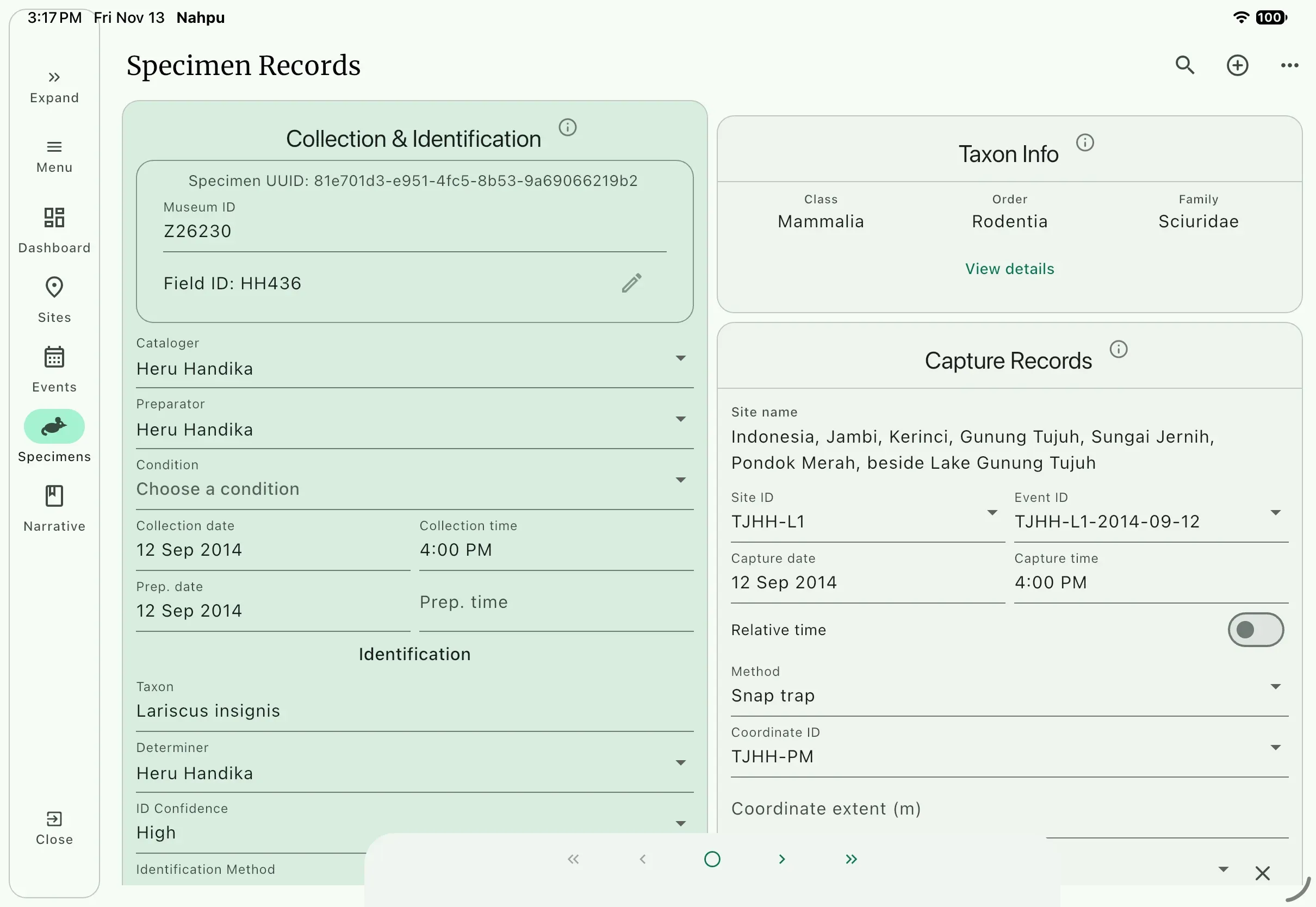
1. Enter HH 436, the complete record
Section titled “1. Enter HH 436, the complete record”HH 436 is a squirrel caught on 12 September, the day the lines were set. The journal for that day says, "I caught a squirrel right after setting the traps." The two records agree.
Open Specimens and select
+. Check that the Field ID readsHH436. If it does not, useEdit field IDto correct the number.NAHPU fills the Field ID from Heru's cataloger number and increases that number by one for each new specimen. In the field this keeps numbers in sequence without anyone writing them by hand. Here you enter only selected records, so the proposed number will often be wrong: after HH 437, NAHPU proposes
HH438, but the next record you enter is HH 442. Override the number withEdit field IDeach time it differs from the paper.In
Collection & Identification:Field Value CatalogerHeru Handika(also fillsPreparatorandDeterminer)Museum IDZ26230Collection date,Collection time12 September 2014, 16:00TaxonLariscus insignis ID ConfidenceHighSet
Prep. dateto the collection date, 12 September 2014. Heru prepared specimens on the day they were caught, but the paper does not record when, so leavePrep. timeempty.In the capture record, choose
Site IDTJHH-L1, then its event. Enter:Field Value Capture date,Capture time12 September 2014, 16:00MethodSnap trapCoordinate IDTJHH-PMCollectorHeru HandikaEnter the measurements: total length
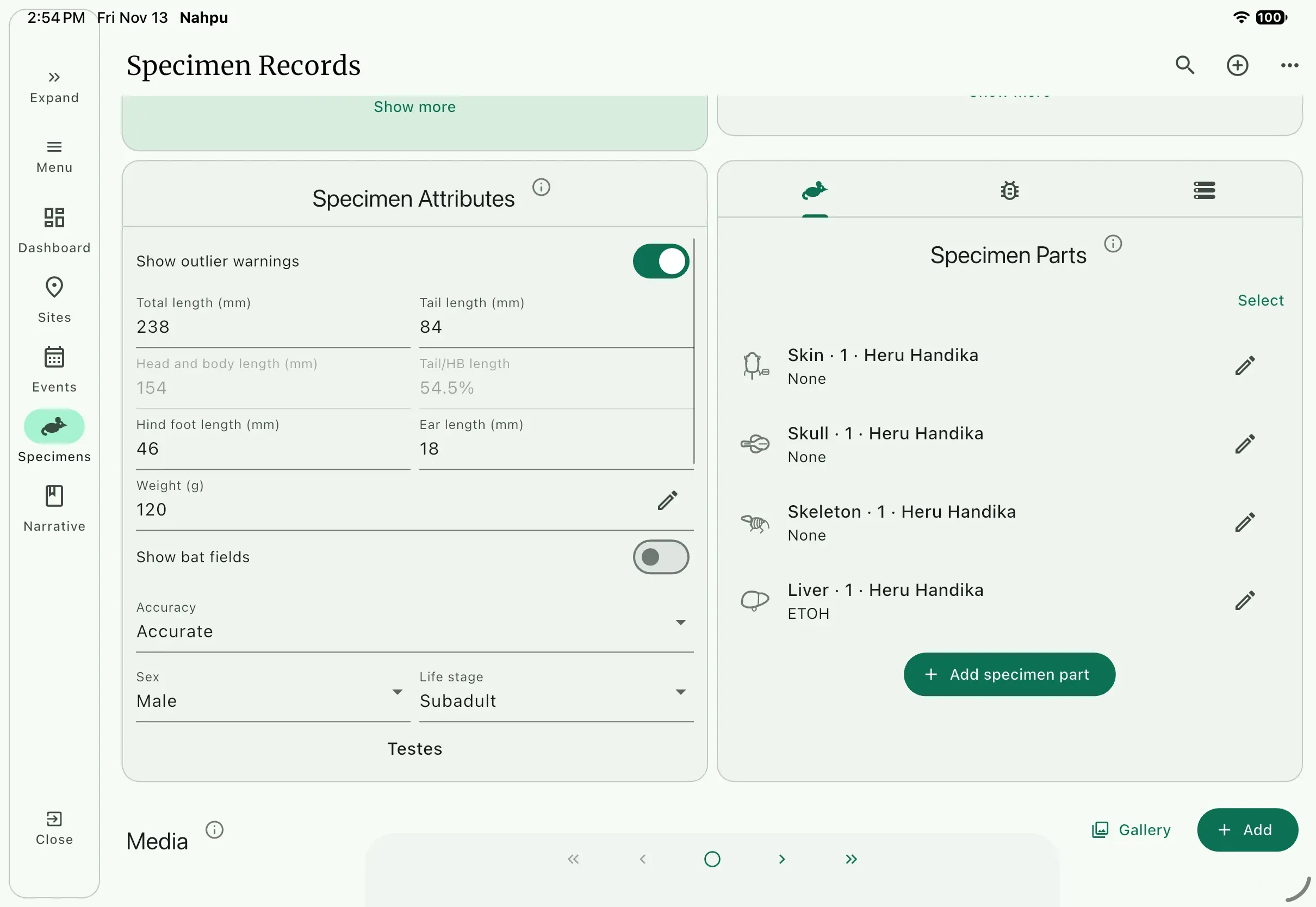
238, tail84, hind foot46, ear18, weight120g. LeaveAccuracyasAccurate.Set
SextoMale, testisPositiontoAbdominal, andLife stagetoSubadult.Under
Specimen Parts, add four parts:Skin,Skull, andSkeleton, each with treatmentNone; andLiverwith treatmentETOH. The paper codeSAbecomes three separate parts, so each can be stored, loaned, and tracked on its own.
Open the record again. Without typing a locality, it shows Indonesia, Jambi, Kerinci, Pondok Merah, the coordinate, and the habitat, all from the site.
Further down the same record are the measurements and parts. NAHPU calculates head-and-body length (154 mm) and the tail ratio from the values you typed:
2. Enter the other six
Section titled “2. Enter the other six”Use the same steps with the values below. The notes after the table explain the choices.
| Field ID | Museum ID | Taxon | Site | Capture date and time | Method | Collector | TTL–TL–HF–Ear, weight | Sex | Life stage | Parts |
|---|---|---|---|---|---|---|---|---|---|---|
HH437 | Z26231 | Mus crociduroides | TJHH-L1 | 13 Sep 2014, 07:00 | Snap trap | Heru Handika | 191–103–22–16, 16 g | Female | Subadult | Skin; skull; skeleton; liver, ETOH |
HH442 | Z26236 | Maxomys hylomyoides | TJHH-L1 | 13 Sep 2014, empty | Snap trap | Heru Handika | 238–119–30–18, 46 g | Female | Empty | Whole body, Formalin |
HH453 | Z26247 | Crocidura beccarii | TJHH-P1 | 13 Sep 2014, empty | Pitfall | Heru Handika | 150–75–17–8, 7 g | Male | Adult | Whole body, Formalin; liver, ETOH |
HH456 | Z26250 | Maxomys hylomyoides | TJBS-L2 | 13 Sep 2014, 07:00 | Snap trap | Heru Handika | 221–113–28–16, 48 g | Male, testes abdominal | Subadult | Whole body, Formalin; liver, ETOH |
HH523 | Z26317 | Maxomys (genus) | TJHH-L3 | 17 Sep 2014, 09:00 | Snap trap | Bima Sampel | 268–124–29–18, 66 g | Male, testes 17 × 4 mm | Adult | Skin; skull; skeleton; liver, ETOH |
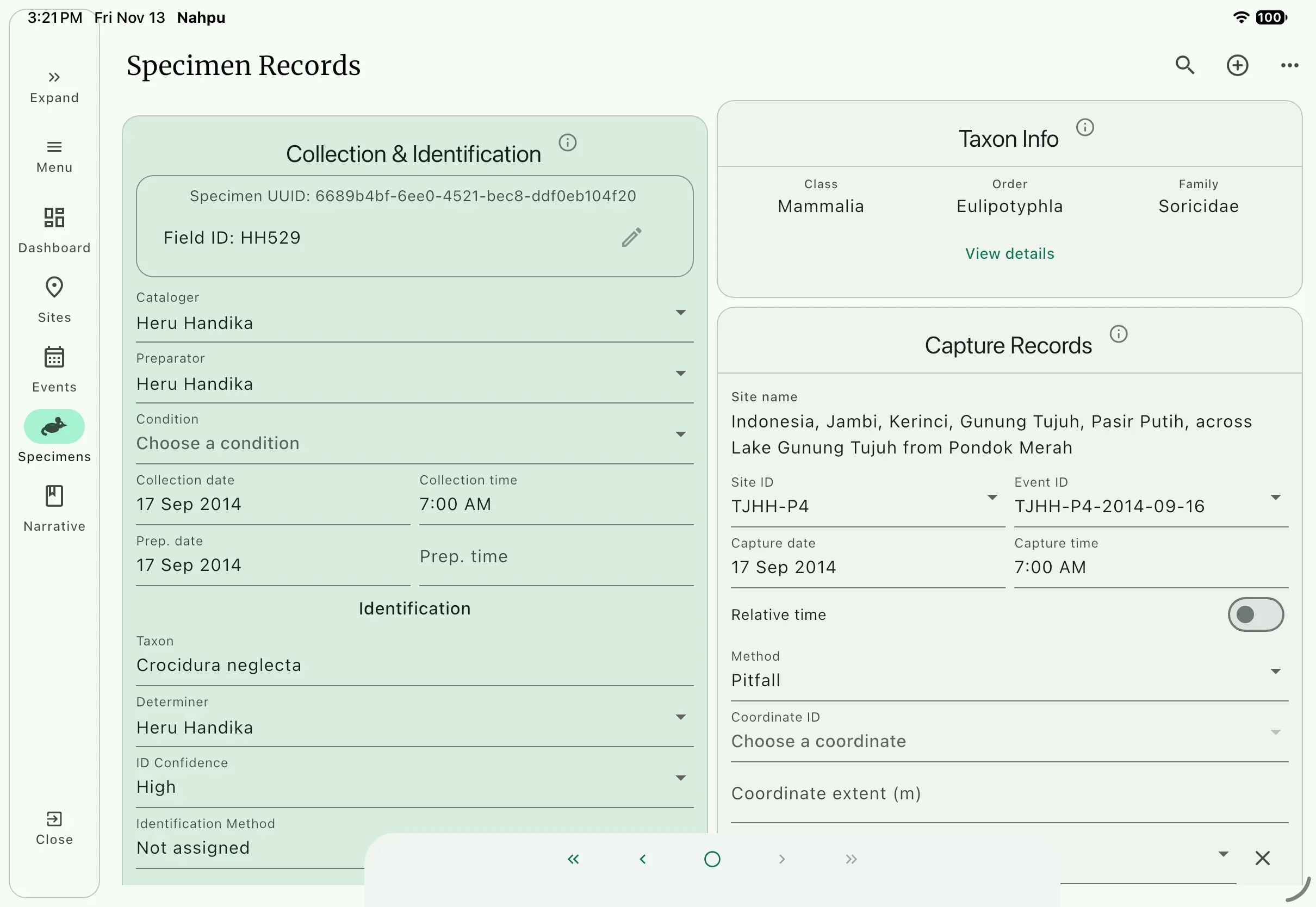
HH529 | Empty | Crocidura neglecta | TJHH-P4 | 17 Sep 2014, 07:00 | Pitfall | Bima Sampel | 112–45–11–7, 4.4 g | Male | Adult | Whole body, Formalin; liver, ETOH |
Copy each date to Collection date and Prep. date as well, and leave Prep. time empty. For the Pasir Putih specimens, leave Coordinate ID empty: those sites have no coordinate. Override the proposed Field ID for each record, as described in step 1.
HH 437: overwritten number and sex
Section titled “HH 437: overwritten number and sex”On paper, 437 is written over 436, and male is scribbled out with female circled. Both corrections look deliberate, so enter HH437 and Female. In NAHPU these mistakes are harder to make: the Field ID comes from Heru's running number, not from memory, and Sex holds one value. Changing it asks Change sex? and clears the reproductive fields that no longer apply, rather than leaving both sets on the form.
Add to Remarks: Paper form: field number written over 436; sex corrected from male to female.
HH 442: the date that breaks the sequence
Section titled “HH 442: the date that breaks the sequence”The form says 17 Sept, but the evidence points to 13 September:
- HH 441 and HH 443, on either side of it, were both caught on 13 September;
- its museum number, Z26236, falls between theirs, Z26235 and Z26237;
- the 17 September captures start much later, at HH 512.
Enter 13 September. The form also leaves the trap line, time, and age blank. Leave the time and life stage empty. A specimen needs an event, so link it to TJHH-L1, where HH 438–441 were caught, and say that this is an inference. The Tissues in box is not circled, so add no liver part.
Add to Remarks: Paper form gives capture date 17 Sep 2014; entered as 13 Sep 2014 from the record sequence and museum numbers. Trap line not recorded; assigned to Line 1 as for HH 438–441.
HH 453: a pitfall capture on "Line 1"
Section titled “HH 453: a pitfall capture on "Line 1"”The form says line 1 and method Pitfall. On paper, Line 1 was both pitfalls and snap traps, so the line number alone cannot tell you which. In NAHPU you choose the TJHH-P1 event, and Method offers only Pitfall. The neighboring record, HH 452, shows why this matters: its method was first written as Snap Trap, then crossed out and replaced with Pitfall.
HH 456: a changed identification
Section titled “HH 456: a changed identification”On paper, Mus crociduroides is crossed out and Maxomys hylomyoides written after it, with no name or date for the change. Enter the current name and set ID Confidence to Medium, since the identification changed in the field. Determiner already names who made it.
Add to Remarks: First recorded in the field as Mus crociduroides.
When a specialist re-identifies the specimen later, they update Taxon, Determiner, and ID Confidence in the same record.
HH 523: the possible new species
Section titled “HH 523: the possible new species”Heru wrote Maxomys cf. hylomyoides: it looks like M. hylomyoides, but he was not sure. Choose the genus Maxomys from the registry and set ID Confidence to High, because the genus is certain.
The form's time is 09:00, not the team's standard 07:00 for overnight captures. Enter it as written and note the difference. The journal also matters for the collector: on 17 September Heru stayed in camp while the boat team checked Pasir Putih, so choose Bima Sampel, who led that team.
Add to Remarks: cf. hylomyoides. Underparts darker than M. hylomyoides: more orange at the base and grey on the belly. Paper time 09:00 differs from the team's standard 07:00.
HH 529: the wrong collector and a misused box
Section titled “HH 529: the wrong collector and a misused box”The form says 07.00, the team's standard time for overnight captures. Enter 07:00; the event notes from Tutorial 4 explain what it means. As for HH 523, Heru was in camp that morning, so choose Bima Sampel as collector.
The Museum box says Blank Tube, which is not a museum number. Leave Museum ID empty and add the note to the liver part's Remarks: Tube label left blank in 2014. Museum and tissue numbers have separate fields in NAHPU, so this kind of note no longer needs a box of its own.
In the finished record, the site and event say Pasir Putih, and Coordinate ID is empty because that site has no coordinate:
3. Check the records
Section titled “3. Check the records”- Turn on
Show outlier warningsand review any flagged measurements. - Open each record and check the Field ID against the paper form.
- Check that the three Pasir Putih specimens show Pasir Putih, not Pondok Merah.
- Check that HH 453 and HH 529 show
Pitfall, and the othersSnap trap.
What you gained over paper
Section titled “What you gained over paper”- No specimen carries a locality of its own, so none can carry the wrong one.
- Method and collector come from the event, so a pitfall capture cannot be filed as a snap-trap capture, and the collector is someone who was there.
- Each name, sex, and life stage is chosen from a list, with one value.
- Every correction is explained in
Remarksinstead of being written over. - Parts are explicit records, not codes that need a legend.