
Some field information has no form field: why a site was chosen, how the forest looked, who fell ill, what puzzled the collector. NAHPU keeps it in narratives, a dated journal in which each entry links to a site and a writer.
Heru's 2014 journal is full of this kind of information. It is also written in the English of someone who failed two English tests that year. Before entering it, correct the language without changing the facts.
How to correct a field journal
Sección titulada «How to correct a field journal»- Keep every fact. Counts, times, places, names, and observations stay as written, even when they seem unimportant.
- Fix the language. Correct grammar, tense, plurals, and word choice. Split run-on sentences.
- Fix names, and say so. Correct a misspelled or outdated scientific name and keep the original in brackets the first time.
- Do not resolve conflicts by editing. If the journal and a specimen form disagree, enter both as written and explain the conflict in the specimen record, as you did in Basic tutorial 5.
- Keep the scan. Attach the scanned page to the entry so anyone can check the original.
1. Compare one entry
Sección titulada «1. Compare one entry»This is the entry for 12 September 2014 in Heru's journal. The teammates' names are redacted.
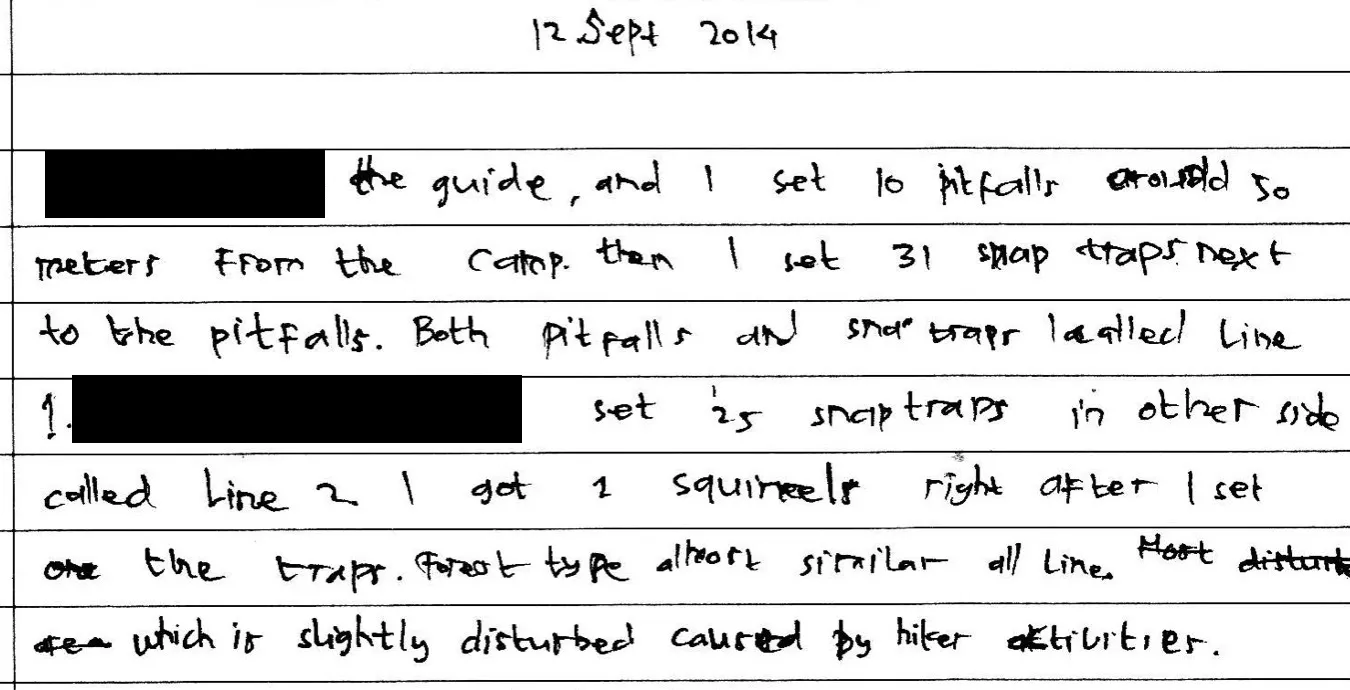
Transcribed as written, with the teammates' names replaced:
Bima, Citra, the guide, and I set 10 pitfalls around 50 meters from the camp.then I set 31 snap traps next to the pitfalls. Both pitfalls and snap trapscalled Line 1. Citra and Bima set 25 snap traps in other side called Line 2.I got 1 squirrels right after I set the traps. Forest type almost similar allline, which is slightly disturbed caused by hiker activities.The corrected version:
Bima, Citra, Eko (our guide), and I set 10 pitfall traps about 50 m from thecamp. I then set 31 snap traps next to the pitfalls; together they formLine 1. Citra and Bima set 25 snap traps on the other side of the camp asLine 2. I caught a squirrel right after setting the traps. The forest issimilar along all the lines and slightly disturbed by hikers.Every number and place survives. The squirrel is HH 436, caught at 16:00 the same day.
2. Enter the entries
Sección titulada «2. Enter the entries»- Open Narratives and select
+. - Enter the
Date, chooseHeru HandikaasWriter, and choose the camp,TJ-CAMP1, asSite ID. - Paste the corrected text. Narratives accept Markdown, so you can italicize scientific names with underscores, such as
_Maxomys hylomyoides_. - Attach the scanned journal page as media.
- Select
Previewto check the rendered text.
Link every entry to the camp, TJ-CAMP1. A narrative's site is where it was written, not every place it describes, and Heru wrote each entry at the Pondok Merah camp, even on days spent at Pasir Putih. That is why one entry can tell the story of several lines: the lines it mentions have their own sites, and the entry names them in the text. Use another site only when an entry was written somewhere else, such as a fly camp away from the main camp.
| Date | What the entry covers |
|---|---|
| 12 Sep 2014 | Lines 1 and 2 set |
| 13 Sep 2014 | First trap check at Pondok Merah |
| 16 Sep 2014 | Boat trip to Pasir Putih; Lines 3–5 set |
| 17 Sep 2014 | First trap check at Pasir Putih |
| 18 Sep 2014 | Lines pulled; the possible new Maxomys |
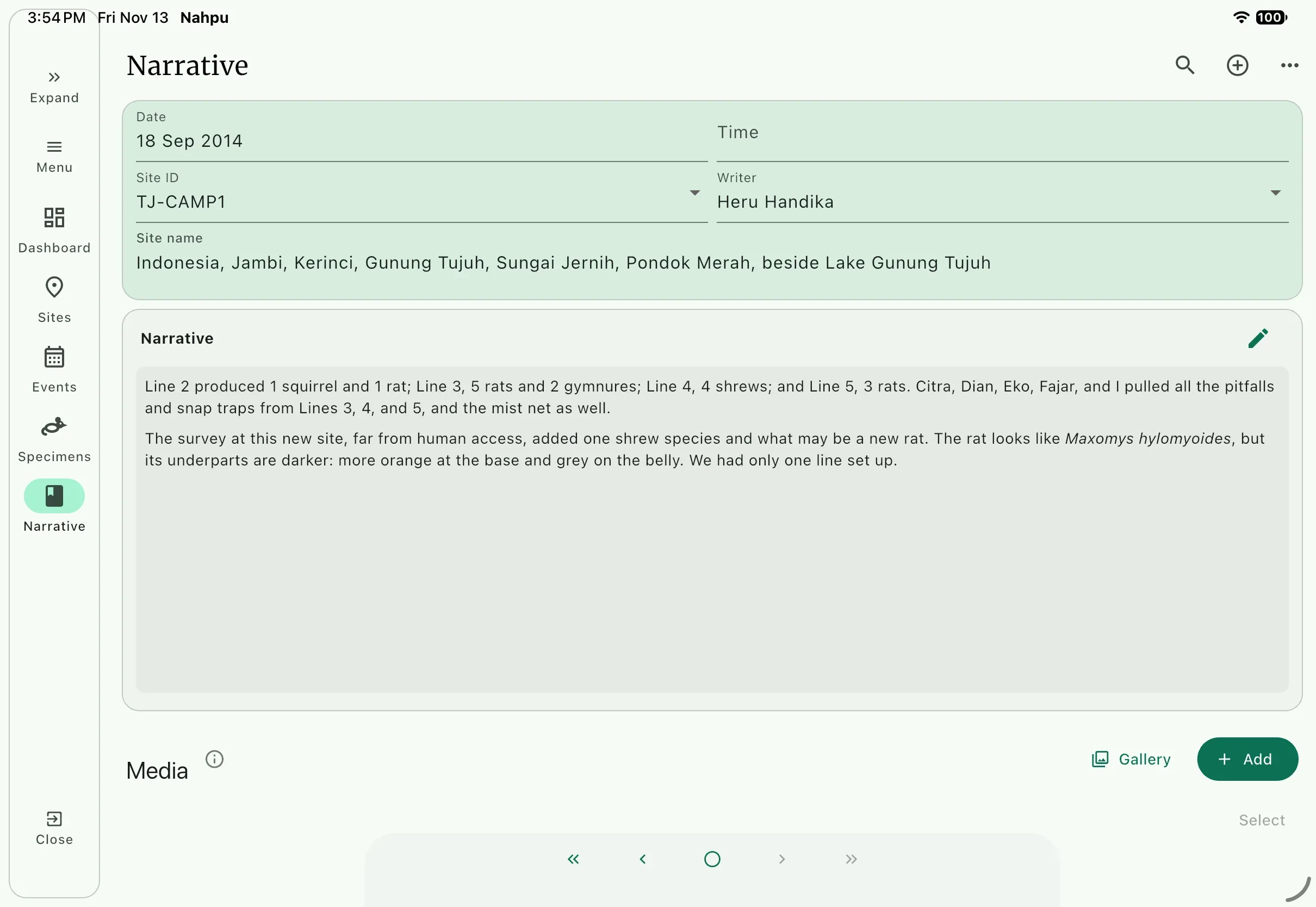
This is the 18 September entry in preview mode, linked to TJ-CAMP1. The Time field stays empty because the journal gives no time for the entry:
3. The corrected entries
Sección titulada «3. The corrected entries»13 September 2014
Sección titulada «13 September 2014»Line 1 produced 14 rats and 6 shrews; all the shrews came from the pitfalls.Line 2 produced 25 rats. Some traps caught more than one animal in a night,because we rebaited them after each capture. The night temperature fell fromabout 16 °C to 14 °C. There was no rain; the sky was sometimes cloudy andsometimes very clear.The rat count for Line 1 is overwritten on paper and reads as 14. The weather is also in the TJHH-L1 event's environmental data, where it can be searched and exported.
16 September 2014
Sección titulada «16 September 2014»Line 1 produced 3 shrews and 1 rat; Line 2 produced nothing. We hired afisherman, Fajar, to take us across the lake by wooden boat. Eko (our guide),Fajar, Bima, Dian, and I took a 1.5-hour boat ride from the camp to a sitecalled Pasir Putih.
The new site was nearly pristine, with very little sign of human activity,unlike the forest near the camp, which hikers have slightly disturbed. On theway we counted five fishermen's shelters at three places, all beside the lake.
Bima and I set 20 snap traps at the first suitable place we found in PasirPutih. The forest there is nearly pristine. I saw only one trail, and it seemedrarely used. There are many big trees for a montane forest, 1–2 m in diameter,and most are covered in moss. The ground is fairly open, with few small plants._Elephantopus_ (an invasive Asteraceae) along the lake edge hides the forestbehind it.
We moved to a second place close to the first and set pitfalls. The forest hereis more open and the ground cover denser, but it looks intact. We think naturalprocesses opened the canopy; there are also fewer big trees than at the firstplace.
At the last place we set 20 more snap traps, next to the pitfalls. This forestdiffers from the other two: open in some areas and closed in others, with manylianas. Bima and I set many of the traps on lianas. The moss cover on the treesis similar to the first place. Because the three places are well separated andhave different forest conditions, I named the first trap line Line 3, thepitfall line Line 4, and the last line Line 5.
While setting the traps, I heard siamangs (_Symphalangus syndactylus_; writtenin the field as _Hylobates syndactylus_) close by. We also found edelweiss nearthe site. We left camp at 09:45 and returned at 16:30.
I felt sick when we got back and had to lie down before preparing thespecimens. Overall, the team was still happy and enjoying camp life after fivenights at high elevation. One thing I don't understand is why we caught so fewbirds compared with mammals, even compared with the average of the surveys wehave done so far.
Bima and Citra set most of the Line 2 snap traps above the ground, about1–2 m high.The descriptions of the three places are also in the habitat of TJHH-L3, TJHH-P4, and TJHH-L5 (Tutorial 3). The journal keeps the full account; the sites keep the part each record needs.
17 September 2014
Sección titulada «17 September 2014»Line 2 produced 2 _Chiropodomys_, 2 _Niviventer_, and 1 _Maxomys_. Bima,Citra, Eko, Dian, and Fajar checked and rebaited the Pasir Putih traps by boat,while I prepared some of the rats in camp. They left at 08:00 and returned at13:15 with 5 rats and 1 gymnure from Line 3, 6 shrews and 1 young gymnure fromLine 4, and 4 rats from Line 5.This entry explains why HH 523 and HH 529 have Bima Sampel as collector in Tutorial 5: Heru was in camp while the boat team checked the traps. Two counts are overwritten on paper and read as 1 gymnure and 6 shrews.
18 September 2014
Sección titulada «18 September 2014»Line 2 produced 1 squirrel and 1 rat; Line 3, 5 rats and 2 gymnures; Line 4,4 shrews; and Line 5, 3 rats. Citra, Dian, Eko, Fajar, and I pulled all thepitfalls and snap traps from Lines 3, 4, and 5, and the mist net as well.
The survey at this new site, far from human access, added one shrew speciesand what may be a new rat. The rat looks like _Maxomys hylomyoides_, but itsunderparts are darker: more orange at the base and grey on the belly. We hadonly one line set up.This is the context for HH 523. Its paper remark, Underpart darker than M. hylomyoides, makes full sense only next to this entry. In NAHPU, both records are in one project: the entry is dated and names Line 3, and HH 523 links to the TJHH-L3 event, so a reader of either can find the other. On paper, HH 523's sheet has no locality, and the journal is a separate notebook.
What you gained over paper
Sección titulada «What you gained over paper»- The journal reads clearly, with every fact intact and the scan attached.
- Each entry is dated and linked to the camp where it was written and to its writer.
- Specimen records and journal entries explain each other: HH 436 and the squirrel on 12 September, HH 523 and the possible new rat on 18 September.