The Basic tutorials take one real field survey from paper to a Darwin Core Archive. Along the way you learn the core of NAHPU: projects, personnel, taxa, sites, collecting events, specimen records, narratives, and export. You also see where a structured catalog keeps data linked and consistent in ways a paper form cannot.
The data come from a young Heru Handika, now the NAHPU project lead. In September 2014 he surveyed small mammals on Mt. Tujuh (Gunung Tujuh) in Kerinci, Jambi, Indonesia. He kept two paper records: a specimen catalog on printed forms and a handwritten field journal. That same year he failed two standardized English tests, and his journal shows it, so in Basic tutorial 6 you also correct the English before you enter it.
The tutorials
Seção intitulada “The tutorials”| Tutorial | You enter | NAHPU idea |
|---|---|---|
| 1. Meet the paper catalog | Nothing yet | Read the source and list its problems |
| 2. Create the project | Project, personnel, taxa | Enter shared context once |
| 3. Create sites | The camp and six trap and pitfall lines | One place, one record |
| 4. Record collecting events | When and how each line was run | The bridge between place and specimen |
| 5. Enter specimen records | Seven representative specimens | Linked, validated fields |
| 6. Correct and enter the journal | Five corrected journal entries | Context that has no form field |
| 7. Review and export | A Darwin Core Archive | Standard data from linked records |
Allow about two hours for the whole series. You need NAHPU on a tablet or computer; a phone works, but the larger screen helps while you learn.
What the paper catalog looks like
Seção intitulada “What the paper catalog looks like”Each specimen sheet holds four specimens under one Locality header. Below is the top of the first sheet: the locality, then HH 436 and HH 437.
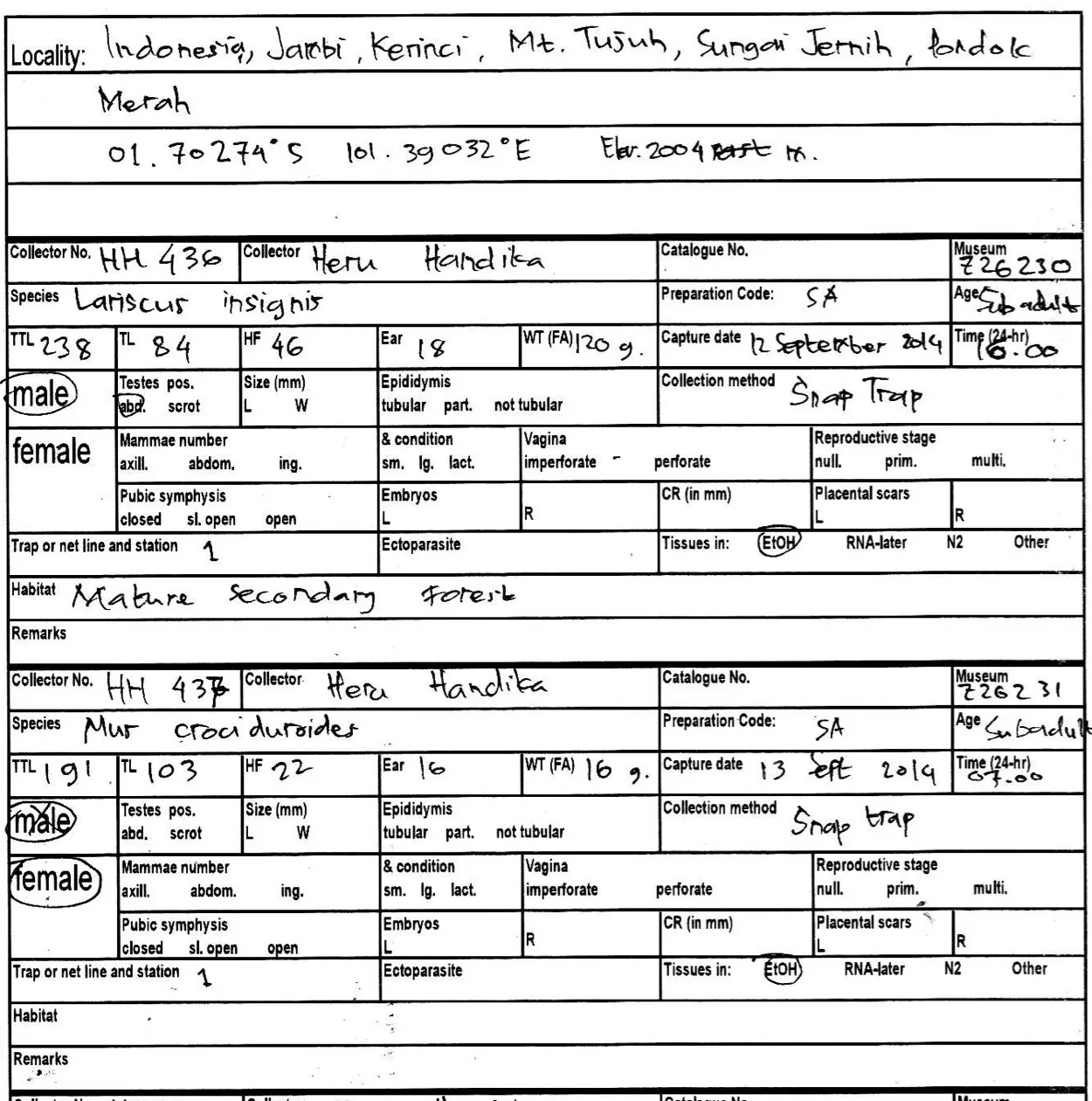
The form asks for many of the right things: collector number, species, standard measurements, sex and reproductive condition, capture date and time, method, trap line, tissues, habitat, and remarks. The trouble is in how the values relate to each other.
The problems in Heru's paper catalogs
Seção intitulada “The problems in Heru's paper catalogs”These are the problems found across the full specimen catalog and journal; the two crops on this page show some of them. Each problem returns later in the tutorial where NAHPU handles it.
| Problem on paper | Example | Where NAHPU handles it |
|---|---|---|
| The locality is written only once per sheet; later sheets leave it blank | Every sheet after the first, including specimens from Pasir Putih, a different place across the lake | Specimens link to an event, and the event to its site (Tutorials 3–5) |
| A unit is crossed out, then changes between sheets | Elev. 2004 feet m. on sheet 1, 2004 m asl on sheet 2 | Elevation is always stored in meters (Tutorial 3) |
| Coordinates use hemisphere letters, with no datum or uncertainty | 01.70274° S 101.39032° E | Signed decimal degrees, datum, and uncertainty fields (Tutorial 3) |
| One species, many spellings | Maxorys, Maxomy, Maxotys, hylomyoider, hylomyoides | Pick each name from the taxon registry (Tutorial 2) |
| Corrections overwrite the original | HH 437: the number is written over 436, and male is scribbled out for female | Fields hold one value, set from a list (Tutorial 5) |
| A struck-out identification with no name or date | HH 456: Mus crociduroides crossed out for Maxomys hylomyoides | Determiner, ID Confidence, and remarks (Tutorial 5) |
| A date that breaks the sequence, plus missing fields | HH 442 says 17 Sept among 13 September records, with no time, line, or age | Records are reviewed in context (Tutorial 5) |
| A standard time with no explanation | Most forms say 07.00. That was the team's standard practice, because no one could tell when an animal entered a trap, but nothing on the form says so | The practice is written into each event's notes (Tutorial 4) |
Line 1 names two methods | Pitfalls and snap traps were both called Line 1 | Separate sites and events per method (Tutorial 3) |
| The collector is always Heru | On 17 September teammates checked Pasir Putih while Heru stayed in camp | Capture Collector chosen from the event's people (Tutorial 4) |
| Habitat filled once, on one specimen | HH 436: Mature secondary forest | Habitat belongs to the site (Tutorial 3) |
| Wrong text in a field | HH 529: Blank Tube in the Museum box | Separate fields for museum and tissue numbers (Tutorial 5) |
| Codes with no legend | Preparation codes SA and AL | Each part is its own record with a type and treatment (Tutorial 5) |
| Tissue circled on some records, not others | HH 442 has no tissue circled | A tissue is recorded only when it exists (Tutorial 5) |
| A remark that only makes sense with the journal | HH 523: Underpart darker than M. hylomyoides | Journal and specimen live in one project, linked by date and line (Tutorial 6) |
HH 523 is the last case. Its sheet has no locality at all, so on paper it looks as if it came from Pondok Merah:
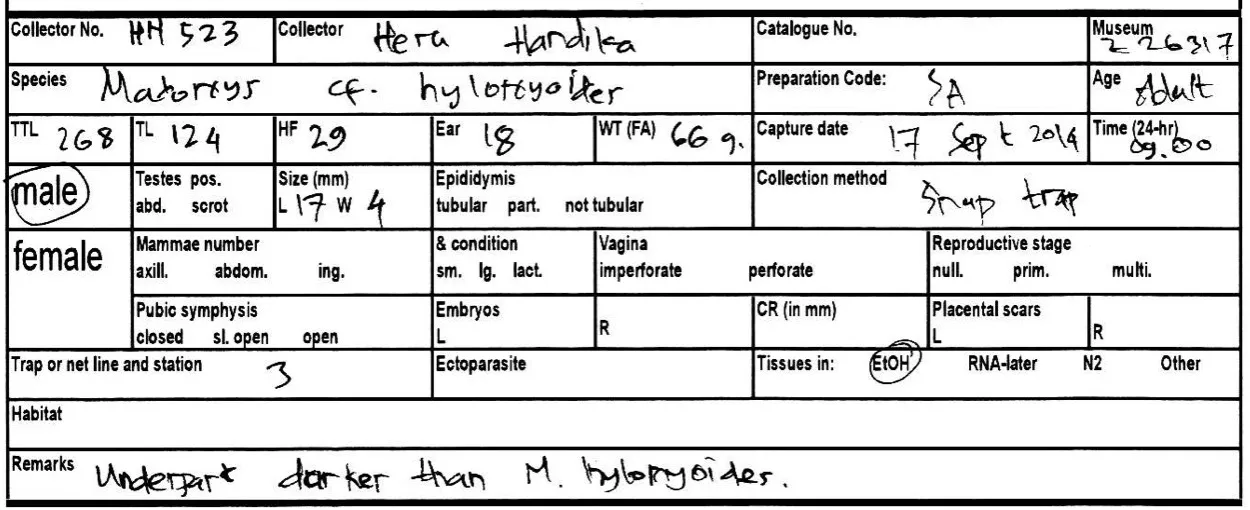
Only the journal for 16–18 September says that Line 3 was at Pasir Putih, 1.5 hours away by boat.
The records you will enter
Seção intitulada “The records you will enter”The catalog has over 100 specimens. These tutorials use seven that cover both survey areas, three methods, and most of the problems above. Where the paper disagrees with itself, the tutorials explain which value is best supported, and why.
| Field ID | Paper name | Name to enter | Line | Why it was chosen |
|---|---|---|---|---|
| HH 436 | Lariscur insignis | Lariscus insignis | 1, snap trap | First record; the only one with habitat; matches the journal for 12 September |
| HH 437 | Mur crociduroider | Mus crociduroides | 1, snap trap | Overwritten number and sex |
| HH 442 | Maxomy hylomyoider | Maxomys hylomyoides | Not recorded | Conflicting date; missing line, time, and age |
| HH 453 | Crocidura beccari | Crocidura beccarii | 1, pitfall | A pitfall capture on a line named for snap traps |
| HH 456 | Mus crociduroides, crossed out for Maxotys hylomyoides | Maxomys hylomyoides | 2, snap trap | Changed identification |
| HH 523 | Maxomys cf. hylomyoider | Maxomys, remark cf. hylomyoides | 3, snap trap | Pasir Putih; remark tied to the journal; time differs from the standard 07:00 |
| HH 529 | Crocidura neglecta | Crocidura neglecta | 4, pitfall | Heru listed as collector while he was in camp; Blank Tube in the museum field |
Measurements, dates, and other values are copied exactly from the paper unless a tutorial says otherwise.
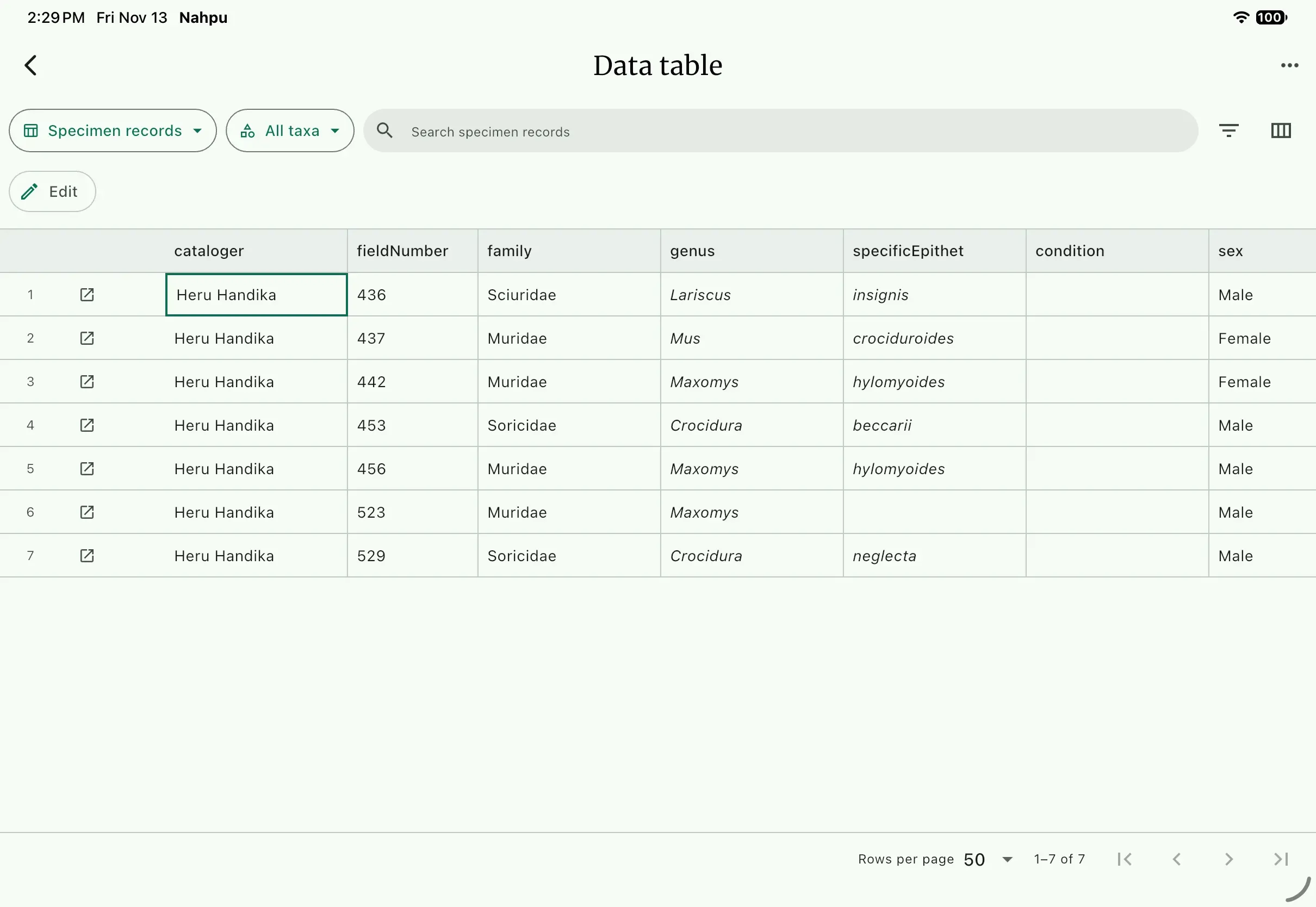
By the end of Basic tutorial 5, the seven records look like this in NAHPU's Data table: