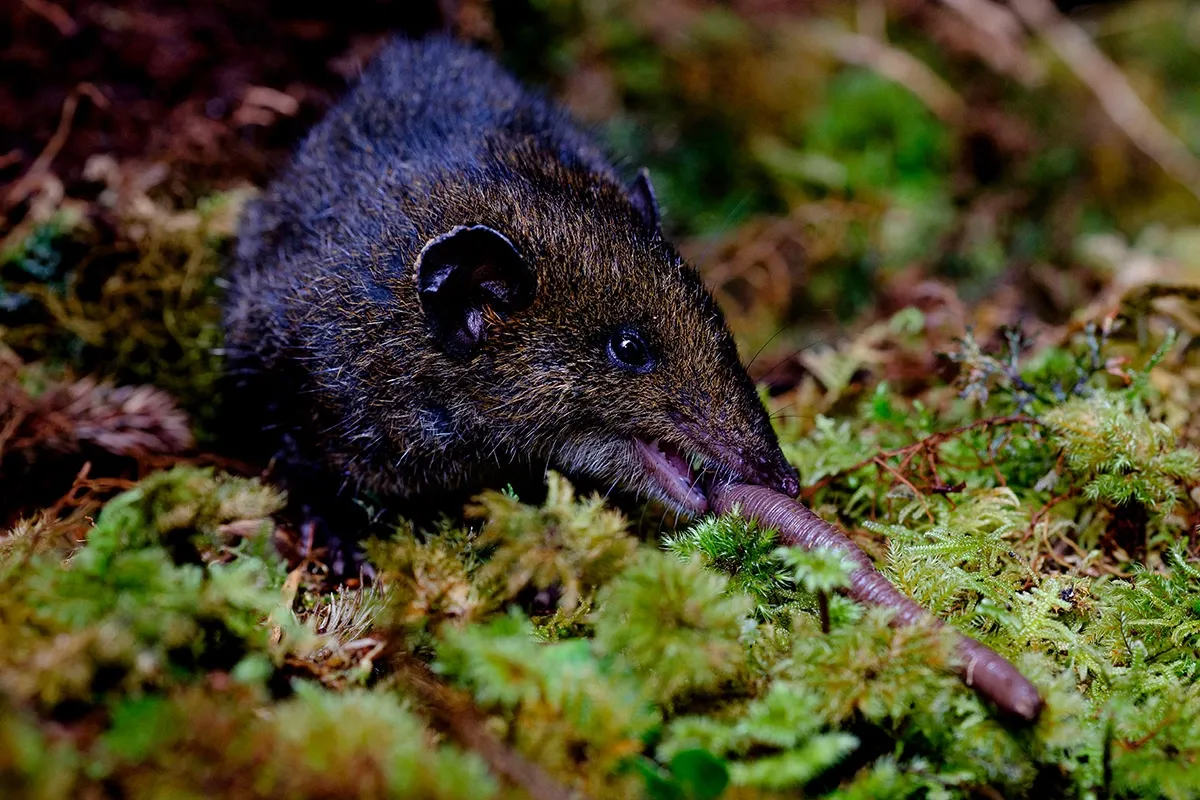
Dr. Heru Handika is a postdoctoral associate at the University of Florida, studying island small-mammal diversity and speciation, with interests spanning in situ diversification, biodiversity informatics, and artificial intelligence. That work has two halves: polyglot, high-performance scientific programming that produces open tools leveraging emerging machine learning techniques and scaling from a phone in the field up to computing clusters, and field expeditions across more than 30 localities, mainly in the remote mountains of Southeast Asia. Dr. Handika is responsible for the overall NAHPU project, including team management, app architecture, user-interface design, conventional and advanced machine-learning features, and integration of all supporting software.
The people behind it
NAHPU Team
23 curators, collection managers, field biologists, and software engineers building NAHPU across museums and universities.
Dr. Andre E. Moncrieff is Curator of Ornithology at the Sam Noble Oklahoma Museum of Natural History and Assistant Professor at University of Oklahoma. His work investigates evolutionary patterns and processes in birds with a focus on population genomics and biogeography. The lab runs in-depth surveys of avian diversity in remote tropical regions, from Andean ridges to Amazonia. Andre and Heru are the two maintainers with full access to NAHPU codebase management. Dr. Moncrieff conceives new app features, designs the bird taxon format, writes documentation, tests the app, and expands collaboration with other museum curators.
Dr. Jacob A. Esselstyn
LSU Museum of Natural Science
Dr. Jacob A. Esselstyn is Curator of Mammals at the LSU Museum of Natural Science and Professor in the Department of Biological Sciences at Louisiana State University. The lab works on island biogeography, phylogenetics, systematics, co-evolution, and community ecology, mostly with small mammals of Southeast Asia and Africa, on the principle that you cannot preserve what you do not know exists. The NAHPU user-interface layout and most of its core design were developed in the Esselstyn Lab.
Dr. Arthur Porto
Florida Museum of Natural History
Dr. Arthur Porto is Assistant Curator of AI Biodiversity at the Florida Museum of Natural History and leads the BioVision Lab, which develops computer vision and machine-learning tools to understand the evolvability of complex organisms and to extract high-dimensional phenotypic data from fossil and extant lineages. Computer vision features and deep integration for genomics and phenomics are currently in development for NAHPU in Porto’s lab.
Dr. Glaucia Del-Rio
Florida Museum of Natural History
Dr. Glaucia Del-Rio is Curator of Ornithology at the Florida Museum of Natural History and Assistant Professor at the University of Florida. A Brazilian field and museum ornithologist and evolutionary biologist, with work spanning speciation, genomics, population genetics, and systematics through to spatial ecology and conservation, and a particular passion for Amazonian birds. Dr. Del-Rio works on the bird features along with developing computer vision features for coloration studies in NAHPU.
Dr. Gregory Thom
LSU Museum of Natural Science
Gregory Thom is Curator of Genetic Resources at the LSU Museum of Natural Science and Assistant Professor in the Department of Biological Sciences at Louisiana State University. The lab studies bird speciation in the tropics, investigating the neutral and adaptive processes that shape genomes, population differentiation, and cryptic diversity across the Neotropics, work that regularly puts the team in a boat in the middle of the Amazon. Dr. Thom conceives the design of the NAHPU tissue management system and oversees its implementation for genomic studies.
Dr. Jonathan A. Nations
Florida Museum of Natural History
Dr. Jonathan A. Nations is Curator of Mammalogy at the Florida Museum of Natural History and Assistant Professor at the University of Florida. He is, working on evolutionary ecology, morphological evolution, macroevolution, biogeography, and community ecology, with a focus on the mammals of the Malay Archipelago. Dr. Nations work is central to the development of the NAHPU mammalogy form and the real-world field testing of the app.
Cody Henderson is a master’s student in Georgia Tech’s College of Computing and a researcher with the Human-Augmented Analytics Group. He is responsible for developing support for new taxon formats within NAHPU via collaboration with research partners and assist with the development of new features and code maintenance.
Dr. Caleb Gordon
Florida Museum of Natural History
Dr. Caleb Gordon is a postdoctoral researcher at the Florida Museum of Natural History, studying the environmental and evolutionary processes behind behavioral innovation in extinct mammals and reptiles. The work combines paleontological methods with phylogenetic machine-learning algorithms and 3D modeling, covering the evolution of aquatic and macrocarnivorous lifestyles in reptiles, and novel AI workflows that assess how climate change affected mammalian functional diversity. Dr. Gordon conceives and oversees the design and implementaion of Paleontology support in NAHPU.
Nurul Inayah
Museum Zoologicum Bogoriense
Nurul Inayah is a researcher at the Museum Zoologicum Bogoriense and the Research Center for Biosystematics and Evolution of the National Research and Innovation Agency, Indonesia, with research focused on small mammals, marsupials, and monotremes. Inayah supports the development of the NAHPU mammalogy form, the real-world field testing of the app in Indonesia, document translation, and developing a NAHPU workshop program for the Indonesian mammalogy community.
Dr. Austin S. Chipps
National Museum of Natural History, Smithsonian Institution
Dr. Austin S. Chipps is an evolutionary biologist at the National Museum of Natural History, Smithsonian Institution, dedicated to collecting and using natural history specimens to answer fundamental questions of mammalian evolution. The research combines fieldwork with comparative genomics and phylogenomics to understand the evolutionary mechanisms underlying the species richness and morphological novelty of small mammals. Dr. Chipps at NAHPU works on quality assurance and field-testing for NAHPU, and support the development of the mammalogy form.
Dr. Ada Chornelia
School of BioSciences, The University of Melbourne
Dr. Ada Chornelia is a postdoc at the School of BioSciences, University of Melbourne, and a bat scientist working on the systematics, ecology, and evolutionary history of bats. The research untangles the taxonomy of cryptic species using multispecies coalescent methods together with integrated taxonomy drawn from morphology, acoustics, and genetics, alongside historical biogeography and stable hydrogen isotopes to track migration. Dr. Chornelia contributes to the development of the bat acoustics form and writes NAHPU documentation and help message translation.
Ashmitha J. Aravind
College of Computing, Georgia Institute of Technology
Ashmitha Julius Aravind is a researcher in the College of Computing at the Georgia Institute of Technology. Aravind works on integrating computer vision into NAHPU for parasite detection and identification, and assist in feature implementation and bug fixing of the app.
Danna Lee
College of Computing, Georgia Institute of Technology
Danna Lee is a researcher in the College of Computing at the Georgia Institute of Technology. Lee works is central on expanding NAHPU support for advance maching learning applications. She is currently designing software architectures for on-device deep learning inference in NAHPU.
Eric Wan
College of Computing, Georgia Institute of Technology
Eric Wan joined the NAHPU team in Fall 2026. Wan is a Master’s student in the College of Computing at Georgia Institute of Technology. Wan is interested in developing NAHPU support for marine invertebrates.
Jia Yu
Georgia Institute of Technology
Jia Yu is a data analyst in the self-driving industry and is working toward becoming an engineer. Yu develops outlier detection for morphometric and spatial data, and encoder models for image and audio analyses in birds.
Lauren Vonnahme
The American Museum of Natural History
Lauren Vonnahme is on the research staff of the American Museum of Natural History. Vonnahme conceives and oversees the design of herpetology support in NAHPU, including the development of the herpetology form and the real-world field testing of the app.
Lawrence Gan
College of Computing, Georgia Institute of Technology
Lawrence Gan is a project collaborator in the College of Computing at the Georgia Institute of Technology. Gan implements various features, expand media viewing capabilities, and assist in feature implementation and bug fixing of NAHPU.
Dr. Marco Rego
Florida Museum of Natural History
Dr. Marco Rego is a museum and field ornithologist at the Florida Museum of Natural History, dedicated to improving the quality of museum specimens and their use in research and outreach programs. The research relies on molecular data alongside GIS tools and analyses to address questions of speciation, biogeography, and the conservation of bird species and subspecies. Dr. Rego contributes GIS expertise and support development of the ornithology form in NAHPU.
Dr. Natalia Pérez-Amaya
Sam Noble Oklahoma Museum of Natural History
Dr. Natalia Pérez-Amaya is an ornithologist and Collection Manager of Birds at the Sam Noble Museum. Her research interests are focused on the phylogeography and ecomorphology of Neotropical birds. Dr. Pérez-Amaya contributes to bird catalog formats, app testing, and documentation and help message translation.
Phillip Kim
College of Computing, Georgia Institute of Technology
Phillip Kim joined the NAHPU team in Fall 2026. Kim is a Master’s student in the College of Computing at Georgia Institute of Technology. Kim is interested on feature extraction from NAHPU media files and developing machine learning models for on-device multimodal analysis.
Dr. Roberta Canton
Clemson University
Roberta Canton is an evolutionary biologist working on how bird plumage colors evolved, with a focus on structural colors studied through spectrometry, electron microscopy, and molecular data. The research interests centre on animal coloration, feather structure, and Amazonian biodiversity. Dr. Canton contributes to the development of the ornithology form and many aspects of the user-interface design of NAHPU.
Shyaam Shanmugam
University of Florida
Shyaam Shanmugam is an undergraduate in Computer Science at the University of Florida, contributing to NAHPU through support for the paleontology expansion, and by extending the NAHPU API features and backend support.
Credit where it is due
Past members and key contributors
People who sustained their contribution to build NAHPU, through feedback and code that is still part of the app today.
- Aakanksha T. Jaiswal
- College of Computing, Georgia Institute of Technology
- Alain Dadaian
- College of Computing, Georgia Institute of Technology
- Danté Evangelista
- College of Computing, Georgia Institute of Technology
- Samantha L. Rutledge
- LSU Museum of Natural Science
Acknowledgments
Thank you for the feedback
NAHPU is a collaborative project among museum and computer scientists. Many thanks to the following people for their contributions and feedback:
Alfath Fanidya, Endah D. Jayanti, Fajar Alfitrian, Lutfi S. Maulidiyah, Akbar F. Hilmi, Darwin Morales-Martínez, Diego J. Elias, Spenser J. Babb-Biernacki, Edward L. Stanley, Jocelyn P. Colella, Jessie L. Williamson, Nicholas A. Mason, Melissa Hawkins, Katrina Derieg, Ellie Dripps, Alivia Hartz, Eleanor Hoeger, Gabriella Linsalata, Lazaro Lopez, John Mewherter, Fritz P. Marcano, Heidi Stevens, Marisa Surovy, Rose Wilhoyt, Litsa Wooten, Lucas H. DeCicco.
Contribute
The team is open
NAHPU grows through collaboration with curators, collection managers, and developers. New taxon formats, translations, documentation, and code contributions are all welcome — as is a conversation about what your collection needs.